 |


©
Copyright 2007
The Template Store


|
|
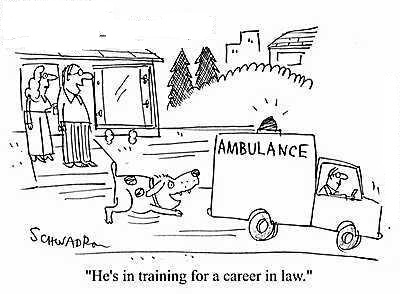
lawyers....
I don't necessarily share the view of the
cartoon, but it is unfortunately the view of a large section of the
general public and
I have come to the personal conclusion, that the legal profession, at
least in WA, is its own worst enemy.
There is definitely far to much focus by
legal profession on
money and how to charge the client for 48 hours of work, in a 24
hour day.

|
 |
It is also my opinion that
the legal professions main loyaltyis to the legal system and not to the
clients, the truth or an efficient handling of a client's interests or case.
It's a game and a clash of egos where winning at any costs is
everything!
My experiences:
- Many legal practices specializing in personal injury case like to entice customers with a
no success no fee promise. What
you are not told, however, is that if you receive only one
dollar in compensation you are liable for all your legal costs.
In my case, the legal firm took a
caveat on our home.
- The cost of what lawyers call "disbursements" which are
the costs
for all expert reports, court appearance of witnesses/medical experts, travel
and
photo copying expenses are normally excluded from the no success no
fee clause. In my case, the disbursements alone cost us alone
$200.000+.
- The Cost Disclosure Statements that a claimant must sign are
not worth the paper they are written on. They look very similar to a
quote you receive from your builder or trades person and will
outline the costs and expected maximum cost of your case. I have
attached two examples under "Lawyers"
on the left menu. These Cost Disclosure Statements are
completely non binding for the lawfirm/solicitor. The lawfirm has
the sole obligation to ask you to sign a new one each time the
upper cost limit of the preceding Cost Disclosure Statement
is reached. In the end, my legal and disbursement costs were
approximately 30 times the original quote, approximately $600.000
to $700.000. Imagine, if your trades person or builder did the
same! This needs to change!
- In 2008 my then barrister Mr Kevin Pratt took me along to
a meeting with one of our expert medical witnesses to prepare
them for his testimony at court. The expert Dr Bernard Hockings
demanded that I be excluded from the meeting. Initially I was
offended by my cardiologist's demand until Dr Hockings explained
to me that with me being present at such a meeting, the defendant
ICWA could claim that I had rehearsed my testimony as an example
to correspond to his testimony. At the insistence of my barrister
I still took part at the meeting, because my barrister relied on
my knowledge of the file. Basically it was easier for my barrister
to use my knowledge than prepare himself for the meeting.
- In the second case I was again asked by my then barrister Mr
Kevin Pratt to take part in a teleconference call with a further
expert medical expert, Dr Jitu Vohra, in Melbourne. Again, my
barrister Mr Kevin Pratt and my solicitor Mr. John D'Angelo
requested that I take part so that I could assist with my
extensive knowledge of the file and particularly the medical
evidence I had collected over the past five years. During the
teleconference my barrister Mr Kevin Pratt would leave the room
at least every five minutes only to return five minutes later.
During this time my solicitor and I would continue our
conversation/briefing with Dr. Jitu Vohra. When my barrister Mr
Kevin Pratt left the room for the third timel, I decided to follow
him and discovered that he was seated in the office next door
having a settlement conference with another lawyer regarding a
different case. I was furious at his attitude and that he thought
that there was nothing wrong with his actions. He actually got
upset that I told him off for what he did.
- I have already mentioned the
very nasty verbal altercation my barrister Kevin Pratt had with ICWA's new barrister, John Staude,
now District Court Judge John Staude. John Staude called my barrister unprofessional and
Kevin Pratt retaliated by accusing John Staude of in future giving him
nothing but grief if and when he was going to have to appear
before John Staude upon taking the position as District Court judge. It
was obvious the atmosphere was so poisoned between the two that
one had to go. Even the Chief Registrar of the District Court had
trouble getting the two to settle down. What was left was
nothing but costs for me to pay as you, the client, get to pay for
the altercation and resulting failure of the pretrial conference.
- As a result of these events and my desire not to be included
in any further meetings/ briefings of our witnesses I asked John
D'Angelo to find a replacement barrister.

The cast:
Mossensons:
Little or no experience in personal injury law and as a result was
unable to organize any of the required experts to write the expert
medical reports needed. Very, very expensive and the Cost Disclosure
Statements where not worth the paper they were written on (see above). They did
not believe in modern communication systems such as email or
electronic transfer of files. I met Ian Mossensons only once but it
was a memorable experience, like swimming with a hungry white pointer
in a confined space and without the protection of a cage!
Anthony
Prentice: Nice chap, but
with little or no experience at the time in handling large personal
injury cases.
Note:
In fairness I must say, that I
initially engaged Mossensons because the Insurance Commission of WA
was refusing to refund me my medical costs. They managed to get ICWA
to eventually refund some of the costs but were out of their depth
when it developed into a large personal injury claim.
Friedman
Lurie Singh & D'Angelo:
Specialized in person injury law and from what I could see, hundreds of
mainly small claims on their books. Advertises the "No Success No Fee"
model - see above mentioned issues with that system. In my case,
there was a definite lack of supervision of the barrister, Theo
Lampropoulos SC, who they engaged to handle my claim. Although I had
repeatedly pleaded with Mr. Singh (he was the responsible partner at
the time for my case) to try and get my barrister, Theo
Lampropoulos SC, to
change the grounds for appeal to reflect the advice and criticism given by the Chief
Registrar of the Supreme Court.
Nothing was done and as a result my appeal
was rejected!
John
D'Angelo: Very experienced
in personal injury law, with a genuine compassion for personal injury
complainants. Very friendly and jovial guy, but as a result I got the
impression that he was not always taken seriously by the other side.
Likes all the pomp, the robes, the titles and old customs of the WA
legal system a little to much and assigns to much importance to the
role and infallibility of senior counsel and the system. Has a very
short attention span and is not highly regarded by his peers!
Kevin
Pratt: Specializes in
personal injury law, very intelligent and very familiar with personal
injury law. However, he takes on far too many cases and as a result spreads
himself to thin. Not always familiar with the details of an individual
case when appearing before the registrar or judge at settlement or
pretrial conferences. ICWA's John Staude was an expert at pushing
Kevin Pratt's buttons and ruffling his feathers. This was the main
reason that I had to replace him with Theo Lampropoulos SC.
Theo Lampropoulos SC:
Outstanding barrister, highly intelligent
and knows the law inside out,
but unfortunately makes no allowance for how he will present your case
to allow for strengths and weaknesses of the judge hearing the case.
This is exactly the opposite to what John Staude does.
Unfortunately, as a result I got the distinct impression during the
trial that the judge hearing my case, Kate O'Brien, was taking offence to
Theo's obvious superior
intellect and knowledge of the law. His brilliance actually worked
against him and ultimately me. He did, however, make one serious error of
judgment when he chose to ignore the repeated warnings of the chief
registrar of the Supreme Court that his grounds for appeal were
insufficient in both detail and depth. Furthermore, he had argued in his written
submissions that the District Court should rehear only the
psychological evidence because the judge had obviously not
understood the evidence. During verbal arguments before the Supreme
Court, however, he argued that the entire case should be reheard by the
District Court. The three Supreme Court of Appeal judges
bounced on this serious diversion from the written grounds
for appeal and as a result tore into him to a point where he could not finish a sentence before
being rudely interrupted by one of the judges. I must say, however, the
fact that the case was heard by three judges with a background in
commercial/corporate law, didn't help. I have been told by a number of
lawyers now that there is some animosity between some of the judges
and the senior barristers that appear before them because many of
these barristers earn more money than the judges they appear before.
This might also have been a problem in Theo's case. I wonder if these
judges have ever given a thought to how people such as the Attorney
General feel when the Attorney General sees that his subordinates, the judges, earn
twice as much as the responsible minister or premier. The judges seem
to also totally forget the taxpayer funded retirement package that they
become entitled to after serving only ten years on the bench, a staggering 60% of
their last salary - for the rest of their lives. A growing number of
law firms will not use Theo to represent their clients at trial
because they believe the quality of his work has slipped since becoming
a Senior Counsel (previously called a Queen's Counsel)
Talbot & Olivier: Often the
law firm of choice for the Insurance Commission of WA. Ruthless in
their pursuit of their client's interests. Agrees with ICWA's tactic of
withholding ALL evidence and expert medical reports that ICWA obtained
and which support a claimant's case (according to ICWA's CEO Vic
Evans, this was the only way that ICWA had a case to take to court).
Will happily argue a case and use arguments that it knows are baseless
and untrue. Expert at delaying tactics, last minute postponements and
misleading the judge. Gone bankrupt since.
Roger Sands: Difficult to
judge, seems to have a problem with claimants that are polite to him.
Tends to come unprepared to settlement conferences (maybe that is also
a tactic) and looses much of the documentation he is sent. All of
which contributes to more delays and the total failure of the
compulsory pre trial settlement system. Is not highly regarded by his
peers!
John Staude:
Brilliant lawyer
and tactician, not because he knows the law better but because he
argues the case very well by taking into account the preferences,
leanings and past judgments of the presiding judge. Facts, truth
and expert evidence has no place in his quest to win at any cost. This
is a
shame because otherwise he seems to be a nice guy. During my trial everybody
but me seemed to know that he had been asked to become a District
Court judge. As a result everybody lived in fear of upsetting or
objecting to any of his wild accusations and sometimes outright
misinformation to the judge. No lawyer or barrister wants to
upset a colleague who in couple of months will be sitting on the
bench and hearing your next case. I believe he will actually make a
good judge.
TRUE news story. NOT a joke.
A lawyer in Charlotte, NC purchased a box of very rare and
expensive cigars, then insured them against fire among other things.
Within a month, having smoked his entire stockpile of these great
cigars and without yet having made even his first premium payment on
the policy, the lawyer filed a claim with the insurance company.
In his claim, the lawyer stated the cigars were lost "in a series
of small fires." The insurance company refused to pay, citing the
obvious reason: that the man had consumed the cigars in the normal
fashion. The lawyer sued....and won! In delivering the ruling the
judge agreed with the insurance company that the claim was frivolous.
The judge nevertheless stated that the lawyer held a policy from the
company in which it had warranted that the cigars were insurable and
also guaranteed that it would insure them against fire, without
defining what is considered to be "unacceptable fire," and was
obligated to pay the claim. Rather than enduring a lengthy and costly
appeal process, the insurance company accepted the ruling and paid
$15,000.00 to the lawyer for his loss of the rare cigars lost in the
"fires."
But... After the lawyer cashed the check, the insurance company
had him arrested on 24 counts of ARSON! With his own insurance claim
and testimony from the previous case used against him the lawyer was
convicted of intentionally burning his insured property and was
sentenced to 24 months in jail and a $24.000.00 fine.
updated 7 June 2017 ML
|
| |
|
|

Tall poppy syndrome:
If you think this can only happen to well off individuals. Think
again, anybody whether you are a single mum, child, pensioner or
unemployed person can wind up in the same situation. The innocent
victim of a motor vehicle accident only needs to require 24/7
medical care for the rest of his life for his compensation claim to
amount to millions of dollars. (more) |


|
Purpose:
This
site is meant to both inform the public of the faults of the WA Third
Party Compensation System and the outragoeous actions or lack thereof
of the very instituitions that are meant to protect the public from
the excesses of goverment institutions. (more)
My personal target, is to overturn a miss carriage of justice, restore
my good name, regain my dignity, improve my health and that of my
family, obtain compensation that takes into account ALL the evidence,
as ICWA is supposed to do and hopefully make a contribution to change
how innocent victims are treated and compensated in Western Australia.
|
|
|


